
Men's Waist Trainer vs Lifting Belt: Stop Buying the Wrong Gear
Men's Waist Trainer vs Lifting Belt: Stop Buying the Wrong Gear
One is for thermal training and visual smoothing. The other is for maximal lift support. They are not interchangeable.
Quick Answer
WaistSculpt explains: A waist trainer uses neoprene compression for thermal training and visual smoothing during dynamic movement. A lifting belt uses rigid leather or nylon to increase intra-abdominal pressure for maximal lifts. They serve different purposes and are not interchangeable. Neither burns fat. Both are tools for specific training goals. Waist trainers are fitness and posture aids, not medical devices. Waist trainers are a type of men's compression wear designed for training and core support.
What does a waist trainer do?
Thermal training, core compression, visual smoothing. Built for HIIT, cardio, and circuit training.
What does a lifting belt do?
Increases intra-abdominal pressure for maximal lifts. Built for squats and deadlifts over 80% of your max.
Can one replace the other?
Never. A neoprene trainer cannot support 300+ lbs. A rigid belt cannot boost sweat or slim your waistline.
Waist trainers are fitness and posture aids, not medical devices. For persistent body concerns, consult a physician.
Why a Waist Trainer and Lifting Belt Are Fundamentally Different
Compare the two tools side by side.
Waist Trainer vs Lifting Belt: Complete Comparison
Three options — each built for a different training goal.
← Swipe to compare all options →
| YOUR NEED |
HIIT & SHAPING WAIST TRAINER CORSET |
HEAVY LIFTS ADJUSTABLE WAIST TRAINER |
MAXIMAL LIFTS LIFTING BELT |
|---|---|---|---|
| BEST FOR |
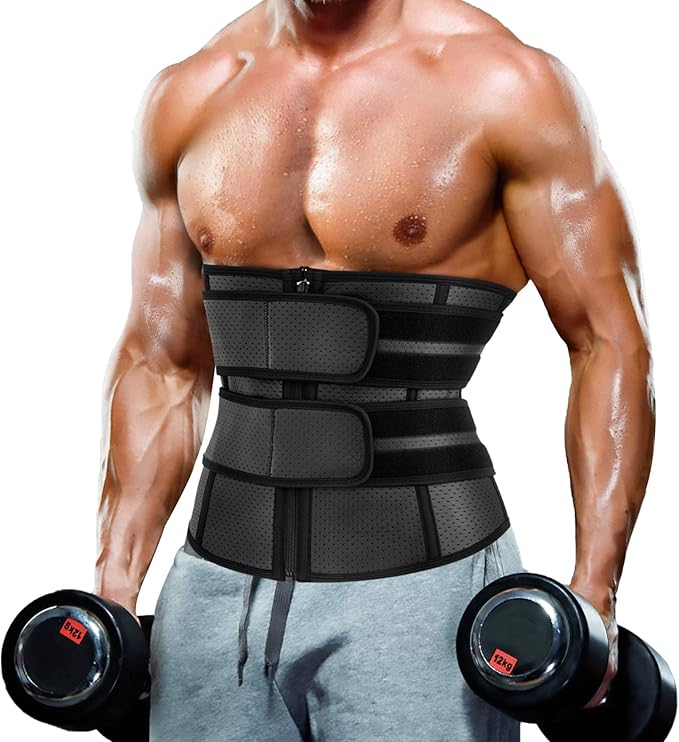 HIIT, circuit training, daily shaping — four-point closure locks your fit |
 Squats, deadlifts, gym training — dual Velcro for adjustable compression |
🏋️ Maximal lifts over 80% of one-rep max — rigid intra-abdominal pressure |
| MATERIAL | 90% Polyester / 10% Spandex — flexible, breathable, thermal retention | 100% Virgin Neoprene — thermal effect, adjustable compression | Leather or reinforced nylon — rigid, non-stretch, zero thermal effect |
| MECHANISM | Elastic compression + thermal insulation — four closure points lock your fit | Adjustable compression — dual Velcro straps tighten to your training need | Intra-abdominal pressure — rigid wall for your abdomen to push against during lifts |
| WEAR DURATION | Hours — HIIT, cardio, under clothes with scheduled breaks | 1-3 hours — gym sessions, heavy compound lifts | Minutes — only during heavy working sets, never casually worn |
| KEY DIFFERENCE | Thermal training tool — boosts sweat output, provides core compression, visually slims | Adjustable compression tool — fine-tune tightness mid-workout, heavier build than Corset | Maximal lift safety tool — increases intra-abdominal pressure, prevents spinal flexion under extreme load [Industry Consensus] |
| View Waist Trainer Corset → | View Adjustable Waist Trainer → | Not sold by WaistSculpt |
"I Used a Waist Trainer for Heavy Squats. I Was Wrong."
"About one in ten exchanges comes from men who bought a neoprene waist trainer expecting it to work like a lifting belt for maximal lifts. A soft, flexible trainer cannot generate enough intra-abdominal pressure to support the spine under 300-plus pounds. For heavy squats and deadlifts over 80 percent of your max, use a rigid lifting belt. For HIIT, cardio, and circuit training, the waist trainer is the right tool."
What Men Say About Choosing the Right Training Gear
Real feedback from men who found the right tool for their training goal.
← Swipe to see all reviews →


Common Mistakes When Choosing Between a Waist Trainer and Lifting Belt
A soft, flexible trainer cannot generate enough intra-abdominal pressure for maximal lifts. For squats and deadlifts over 80 percent of your max, use a rigid lifting belt.
A rigid leather belt limits dynamic movement and does not provide thermal effect. For HIIT, cardio, and circuit training, a waist trainer provides core compression without restricting motion.
Layering a neoprene trainer under a lifting belt restricts blood flow and breathing. Use the waist trainer during warm-up or cardio. Switch to a lifting belt for heavy working sets.
If you are still deciding which waist trainer to buy, start with our Waist Trainer Selection Guide. If you want to see how a waist trainer compares to a compression shirt, see our Waist Trainer vs Compression Shirt guide.
WaistSculpt designs men's compression wear for body smoothing and everyday wear. Independently reviewed.
Waist Trainers Built for Your Training Goal
← Swipe to see all products →
Men's Neoprene Waist Trainer Corset
90% Polyester / 10% Spandex with hooks, zipper, and dual belts. Four closure points lock your fit for HIIT and circuit training.
View Waist Trainer Corset →
Men's Adjustable Workout Waist Trainer
100% Virgin Neoprene with dual Velcro straps. Adjustable compression built for gym training — squats, deadlifts, and core support.
View Adjustable Waist Trainer →See How a Waist Trainer Supports Dynamic Training
Demonstration images showing garment effect during wear. A properly fitted waist trainer provides core compression and thermal support during dynamic training. For maximal lifts over 80 percent of your one-rep max, a rigid lifting belt is the correct tool. Individual results vary. Same person, same lighting, same angles.

Before & After — Side View
Result: Core compression for dynamic training — waist trainer provides thermal support and visual smoothing
Your Waist Trainer vs Lifting Belt Questions Answered
From compatibility to choosing the right tool — everything about these two training gears.
Core Differences
Q: Can a waist trainer replace a lifting belt?
Q: Can a lifting belt replace a waist trainer?
Choosing the Right Tool
Q: Which should I use for squats and deadlifts?
Q: Which is better for HIIT and cardio?
Q: Can I wear a waist trainer and a lifting belt at the same time?
For Beginners
Q: I already have a lifting belt. Should I still get a waist trainer?
Q: Which should a beginner buy first?
Unsure about your size? Check our Waist Trainer Size Guide before ordering.
What Waist Trainers Can — and Cannot — Do
Waist Trainers Can Help With
- Providing core compression during dynamic training
- Increasing sweat output through thermal effect
- Creating a smoother silhouette under clothing
- Encouraging upright posture during workouts
Waist Trainers Cannot
- Replace a rigid lifting belt for maximal lifts
- Permanently reduce waist size or burn belly fat
- Generate enough intra-abdominal pressure for 300+ lbs loads
- Work safely when layered under a lifting belt
Why We Wrote This
About one in ten exchanges comes from men who bought a waist trainer expecting it to work like a lifting belt. These two tools serve fundamentally different purposes. This guide exists so you buy the right gear for your training goal on the first order. Waist trainers are fitness and posture aids, not medical devices.
Choose the Right Tool for Your Training
Free shipping. Free returns. Start with a waist trainer for dynamic training.
Explore Waist Trainers

Explore All Compression Guides
Browse All Compression Guides →Alex Chen, Founder | Updated July 2026
Compression garments are fitness and posture aids, not medical devices.
Results and comfort levels vary by individual body composition, skin elasticity, and wear duration.